by Jordan Crump
I want to share one technique for looking at art called Visual Thinking Strategies, which can be applied to anything visual such as children’s books or art exhibits. It asks three questions, again and again: What is happening in this image? What do you see that makes you say that? What more can you find? These questions are open-ended, with no wrong answers.
After you’ve spent time looking at the artwork, you can read the label (aka a tombstone in art museums) and the exhibit statement for more information about the piece. You can revisit the questions and your earlier observations with the new details you've learned.
You can do this with yourself, but I encourage you to try it with someone from your Community Group or your family the next time you’re at church. When you’re looking at a piece, you can consider the elements that make up the composition—like line, shape and form, color and value, space, and texture.
This process encourages slow, intentional looking. A study done over twenty years ago at the Metropolitan Museum of Art found that on average folks only spend 27.2 seconds looking at a work of art. In our age of endless scrolling, taking more than 30 seconds to look at something seems even harder.
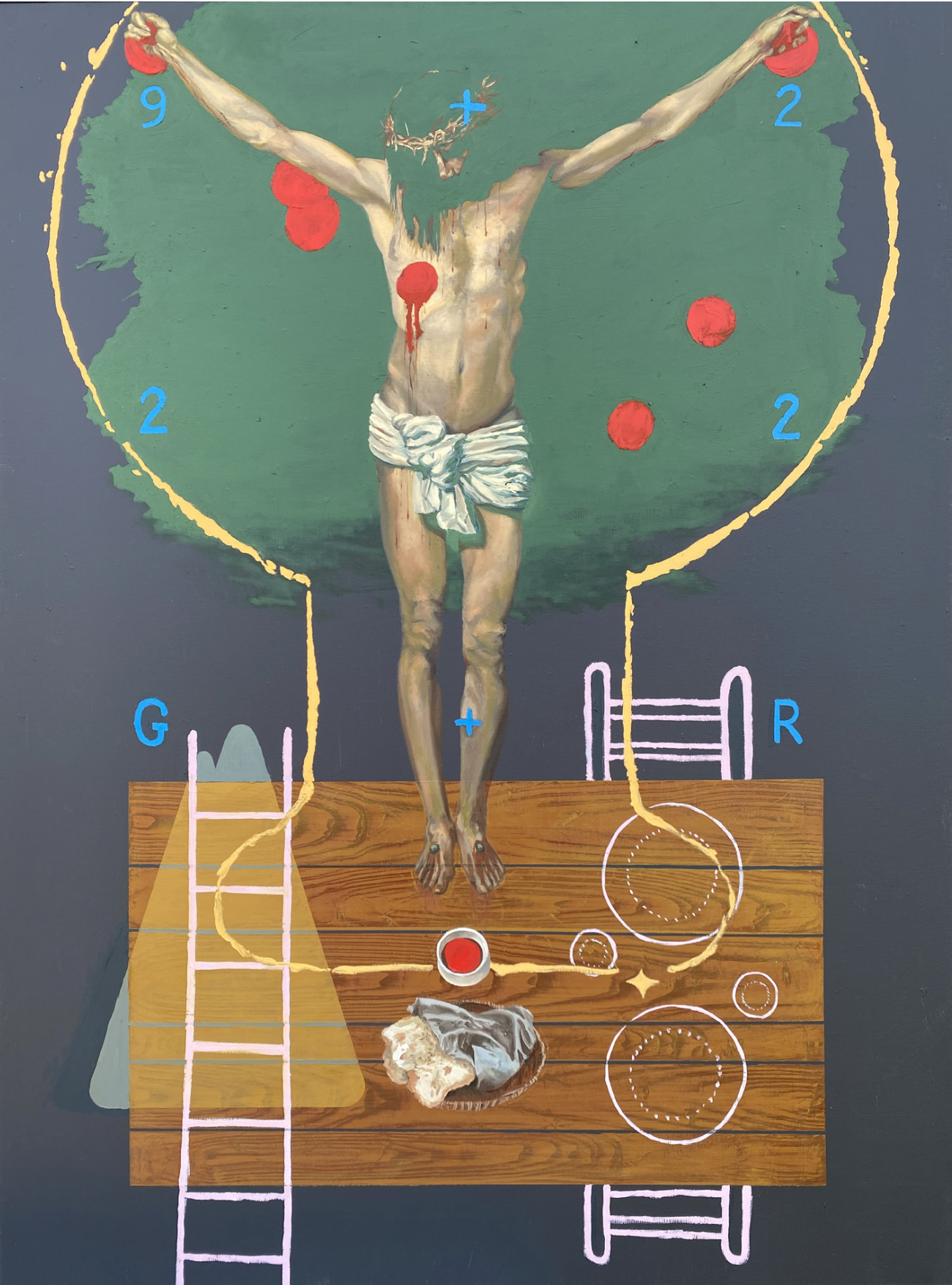
Rooted and Liminal No. 5 by Craig Hawkins. Oil on Canvas, 36” x 48”
So let’s look at this piece by Craig Hawkins with Kevin, Rochell, and Adam. It’s titled Rooted and Liminal No. 5, and it will be on display at Sojourn Arts in the exhibit Manifest, opening tomorrow.
Jordan: What is happening in this image?
Rochell: So, I see communion. I see communion because I see the bread and the wine. And I see a table because these are just plates and cups and the ladder is also chairs, if you think about it.
Adam and Kevin: Whoa.
R: And then I also see from Genesis to Revelation.
J: What do you see that makes you say from Genesis to Revelation?
R: The G to the R.
A: I see that now, that's really cool.
K: I see the tree.
J: What makes you see a tree, Kevin?
K: The green, right. And it's in the shape of a tree. And then the red little dots, kind of like fruit.
J: What else is happening in this image?
A: The yellow is also like a cup, like of His sacrifice, His blood poured out. That's kind of what I was thinking with it too.
K: Also, we see Jesus, a person representing Jesus.
A: I see numbers. Ro was wondering what they stand for.
All: [Laughter]
J: Okay, we see numbers. We are not quite sure what they stand for.
A: It might represent a verse, but I don't know what it is. I thought this was a triangle, like, maybe the gold triangle is the Trinity.
R: I interpreted it as a mountain. I saw a mountain because of the shape of it.
A: That's good. The ladder…Maybe Jesus coming down from on high to us.
J: Yeah, so maybe the ladder represents Jesus coming down. Maybe the ladder could be like Jacob's ladder, too.
A: And I think these are chairs because of the place setting of, like, again, this idea of we have a spot at the table.
And it’s as simple as that! Our group then read Craig’s artist statement for more context about the series, adding to our understanding of the work.
Manifest features paintings by Craig Hawkins and Matt Armstrong. It opened on Friday, September 11th and is on view through Sunday, November 8, 2026.
This post originally existed as an email sent to Sojourn Midtown members.