You Can Never Hold Back Spring: Observations from Self-Isolation by Michael Winters

by Kevin Janes

As I’m confined to my home and immediate surroundings like most of our community, the most striking observation I’ve made is how my attention is piqued like no other time in my life since childhood. Alongside the anxiety and uncertainty of the times, I’m reminded of what author David Dark calls his “attention collection,” those things you notice, are moved by, and catalogue in some special corners of your brain and heart for fond recollection later (apologies to David Dark for maybe missing the mark on that definition!). 

Music and nature are two things I hold dear, so it’s no wonder I’ve got a heightened awareness of the power they both have to inspire and comfort during this new (ab)normal pace of life. For the last month as I’ve gazed out the window watching birds and squirrels, or taken solitary walks in my neighborhood tracing the origin and ending of a creek that runs through it, I’ve watched God’s annual re-creation we call spring unfold like one of those flipbook animations. Subtle progressions greet me daily: a new bud here, a flash of color there, wild babies, birdsongs, earthen scents, solar warmth. Recurring companions I’ve been meditating with have been a quiet tune by Tom Waits called “You Can Never Hold Back Spring,” and Luke 12:22 – 31 (don’t be anxious, consider the lilies…). Perhaps an odd pairing, but these are odd times: 

You can never hold back spring / You can be sure that I will never stop believing
The blushing rose will climb / Spring ahead or fall behind
Winter dreams the same dream every time / You can never hold back spring
Even though you've lost your way / The world keeps dreaming, dreaming of spring

So close your eyes, open you heart / To the one who's dreaming of you
You can never hold back spring / Remember everything that spring can bring
You can never hold back spring…

Tom Waits, from Orphans: Brawlers, Bawlers & Bastards, 2006

“Do not be anxious about your life, what you will eat, nor about your body, what you will put on. 23 For life is more than food, and the body more than clothing. 24 Consider the ravens: they neither sow nor reap, they have neither storehouse nor barn, and yet God feeds them. Of how much more value are you than the birds! … 27 Consider the lilies, how they grow: they neither toil nor spin,[b] yet I tell you, even Solomon in all his glory was not arrayed like one of these. 28 But if God so clothes the grass, which is alive in the field today, and tomorrow is thrown into the oven, how much more will he clothe you, O you of little faith! 29 And do not seek what you are to eat and what you are to drink, nor be worried. 30 For all the nations of the world seek after these things, and your Father knows that you need them. 31 Instead, seek his kingdom, and these things will be added to you.”   

Luke 12: 22-24, 27-31, ESV

 Our world is a strange and wonderful place. For those of you that enjoy compilations and lists like I do, here are some further observations, both natural and musical, from my Attention-Collecting-Self-Isolation, Spring 2020 Edition:

-  I saw two cardinals kiss the other day! It happened under a tulip in bloom – call it April mistletoe. Their bills clicked with a tiny sound like a toothpick snapping. Then I saw it happen again on the fencepost a few days later. Who knew avian mating rituals could be such a dopamine hit.

-  My daughter and I were on a walk and saw a squirrel scurry up a tree with a 6-inch diameter pancake hanging out of his mouth. Our startling presence made him drop most of it, but I’m sure he went back for it later.

-  My daughters got recorders in their Easter baskets this year. Of course they quickly learned to play the proverbial recorder jam, "Hot Cross Buns." While they played a duet of the tune, I was outside puttering around the yard and heard a mockingbird tweeting the tune! Mockingbirds are known for mimicking other birds' songs, and the occasional car alarm sound, but I've never heard one sing "Hot Cross Buns."

-  A robin kept flying into our garage scoping out nesting places. I closed the overhead door every evening and she’d sit on the fencepost watching me with either confusion or disdain. So she’d changed course and is actively constructing one our electric panel box outside the kitchen window. We’ll leave this one be and see if we get any babies in a few weeks.

-  A pair of likely migrating water birds (herons, cranes, egrets – we can’t be sure) landed in our neighbor’s backyard this morning. Good thing their Great Pyrenees wasn’t outside at the time.

-  You’ve likely seen colorful sidewalk chalk art and games from kids in your neighborhood, but have you seen a woman walking a dog jump a hopscotch course without missing a beat? Happened in the 2500 block of Hillbrook Dr, Hikes Point.

-  Also inspired by spring, Louisville singer-songwriter Joan Shelley has been busy writing and recording in self-isolation. Check out these new singles, “Blue Skies” and “Between Rock & Sky.” Spare $2 and download them if you can. Touring artists’ income has ground to a halt this spring, and the summer is in question as well.

-  Strange times can provide beautiful opportunities. Chance The Rapper read Matthew 11:28 on national television the other day (Then Jesus said, “Come to me, all of you who are weary and carry heavy burdens, and I will give you rest.” NLT). He’s open about his faith, so a public recitation from him isn’t a surprise, but the kicker is that Late Show host Stephen Colbert asked him to

-  Here’s an oddity: After nearly 60 years of legendary recordings, Bob Dylan finally scored his first (gasp!) Billboard #1 hit single last week. No, it wasn’t an anniversary re-issue of “Like a Rolling Stone” or “Blowing in the Wind.” It was a surprise-released  17-minute murder ballad called “Murder Most Foul” about the 1963 assassination of President John F. Kennedy. It’s a mesmerizing, meandering opus that references over 70 other songs, prompting NPR Music to compile a playlist of them.

-  Finally friends, we lost two of our best songwriters in the last month, Bill Withers from heart disease (age 81), and John Prine from complications from COVID-19 (age 73). True American treasures, both men were more in tune with the beauty and hilarity, loveliness and ugliness, and joy and sorrow of humanity than most writers that ever dared tell a story. There’s a plethora of tributes, past concert footage, and music to hear online from both artists, so enjoy that virtual rabbit hole if you so choose. 

-  While no man is perfect apart from Jesus, is there such a thing as a “perfect” song? Yes there is. Also, here's a great mini set by Bill Withers recorded in 1972.

-  Lastly, here's a lovely remembrance of John Prine from Pitchfork, along with a few classic live videos, particularly "Hello In There" and "Bruised Orange."  

Artist Emulation: Nina Katchadourian by Michael Winters

by Jordan Lienhoop

On our Instagram, we’ve started a series called "Artist Emulations,” inviting people of all ages to make artwork inspired by artists we admire. To emulate an artist is similar to imitating that artist's ways of working, but it's not the same as copying. By emulating another artist you can learn to appreciate their work more, notice what they notice, and experience a new way of making.  

“Topiary” by Nina Katchadourian

“Athletics” by Nina Katchadourian

The first artist we selected is Nina Katchadourian, an interdisciplinary artist living and working in Brooklyn. She began her project “Seat Assignment” in 2010, challenging herself to create art during flights with just her camera phone and the materials around her. What a perfect challenge for people at home right now! We asked our followers to create new images with magazines and snacks from their kitchen or pantry.

Here are the images inspired by Nina’s work:

by Savannah Hart

by Rachel Szabo

by Rachel Szabo

by Sammi Lawson

by Jordan Lienhoop

Opportunity to Repent by Michael Winters

by Michael Winters

"Jonah and the Whale", Folio from a Jami al-Tavarikh (Compendium of Chronicles), ca. 1400Click on the image for more information via The Met.

"Jonah and the Whale", Folio from a Jami al-Tavarikh (Compendium of Chronicles), ca. 1400

Click on the image for more information via The Met.

This past Sunday’s sermon from Pastor Jamaal focused on repentance. He argued that whatever million things God is doing through this pandemic, it’s a good time for all of us to repent. (Listen to the sermon here, or watch the whole service here.) The sermon primarily looked at the book of Joel, but after coming across Dan Albergotti’s great poem “Things to Do in the Belly of the Whale” this morning, I thought about the connection between the sermon, repentance, and the book of Jonah.

Jonah is called by God to preach to “the great city Nineveh,” but he refuses. As he tries to escape God’s direction by boat, God sends a storm. Jonah ends up getting thrown off the boat and swallowed by a fish, remaining stuck there for three days and three nights.

[Holy week sidenote: Don’t you love Jesus’ statement in Matthew 12:40? “For as Jonah was three days and three nights in the belly of a huge fish, so the Son of Man will be three days and three nights in the heart of the earth.” It must have seemed such an odd thing to say before anyone could’ve imagined his resurrection.]

Jonah chapter 2 records Jonah’s own poem-prayer spoken in the belly of the whale:

“In my distress I called to the Lord,
    and he answered me.
From deep in the realm of the dead I called for help,
    and you listened to my cry.
You hurled me into the depths,
    into the very heart of the seas,
    and the currents swirled about me;
all your waves and breakers
    swept over me.
I said, ‘I have been banished
    from your sight;
yet I will look again
    toward your holy temple.’
The engulfing waters threatened me,
    the deep surrounded me;
    seaweed was wrapped around my head.
To the roots of the mountains I sank down;
    the earth beneath barred me in forever.
But you, Lord my God,
    brought my life up from the pit.

“When my life was ebbing away,
    I remembered you, Lord,
and my prayer rose to you,
    to your holy temple.

“Those who cling to worthless idols
    turn away from God’s love for them.
But I, with shouts of grateful praise,
    will sacrifice to you.
What I have vowed I will make good.
    I will say, ‘Salvation comes from the Lord.’”

At this stage of life, as most of us are staying home much more than normal, it’s probably easier than usual to imagine what it would be like to be stuck inside the belly of a whale, cut off from regular routine and experiencing social isolation.

Dan Albergotti’s poem, “Things to Do in the Belly of the Whale” is especially instructive for us now.

Things to Do in the Belly of the Whale
Dan Albergotti

Measure the walls. Count the ribs. Notch the long days.
Look up for blue sky through the spout. Make small fires
with the broken hulls of fishing boats. Practice smoke signals.
Call old friends, and listen for echoes of distant voices.
Organize your calendar. Dream of the beach. Look each way
for the dim glow of light. Work on your reports. Review
each of your life’s ten million choices. Endure moments
of self-loathing. Find the evidence of those before you.
Destroy it. Try to be very quiet, and listen for the sound
of gears and moving water. Listen for the sound of your heart.
Be thankful that you are here, swallowed with all hope,
where you can rest and wait. Be nostalgic. Think of all
the things you did and could have done. Remember
treading water in the center of the still night sea, your toes
pointing again and again down, down into the black depths.

“And the Sea Stopped Raging”, print by Barry Moser, part of the Pennyroyal Caxton Bible.

“And the Sea Stopped Raging”, print by Barry Moser, part of the Pennyroyal Caxton Bible.

Repentance doesn’t come immediately. Repentance isn’t usually the first thing on our minds unless it becomes absolutely necessary. I can’t imagine that the level of self-awareness, and God-awareness, expressed in Jonah 2 set in as soon as Jonah plopped into the belly of the big fish. It would take a while to get your bearings. You’d have to look around and “count the ribs.” You’d need to settle down and “Listen for the sound of your heart.” You’d have to get to thankfulness for your weird and challenging circumstances. You’d have to consider your life, your actions. Then maybe true repentance would overflow. It seems this is the challenge before us, too.

If repentance is within you, let it out. Maybe write a poem-prayer of your own. Sit down and give yourself space and time to get there. If you write something, I’d love to see it. You can email mwinters@sojournchurch.com.

Notes: Thanks to Austin Kleon, who always points out so much good content, including the “Things to Do in the Belly of the Whale” poem above. He made this collage in response to the poem.

It looks like the book which includes the poem above, The Boatloads by Dan Albergotti, is out of stock on Amazon, but I ordered a copy direct from the publisher this morning.

You are a pilgrim who has already arrived by Michael Winters

by Michael Winters

Imagine yourself standing in front of your childhood home. See the color of the front door. Remember what you can about what is behind each window.

Now, where did you move after you left this home? Imagine yourself walking there. It might be far away. It might take you a week or a month to walk there. That’s okay. You are a pilgrim on your way.

Keep walking to each home that has been your home. Stop in front of each one. Remember what you can and keep going.

You eventually come to your current home, the place where you live. You eventually come to today, sitting in your chair, looking at the screen, reading.

You are a pilgrim. You arrived here. This was your destination. I know, I know, it’s not your permanent destination, but you can’t know much about that, so don’t worry about it. This was your destination. You are here. You are a pilgrim.

“Google maps sketch of a future walk: Coming home from every home I’ve lived in” by Michael Winters

“Google maps sketch of a future walk: Coming home from every home I’ve lived in” by Michael Winters

I’ve sometimes used walking as an important structure to my art projects, like in Where the Good Way Is or Every Minute to the Other Side of the Valley. I set a pre-planned route and make photographs along it. The text and map above describe a walk I’d like to do, but haven’t yet. I’d like to walk home from every home I’ve lived in. (Full disclosure: this map skips the house I lived in until I was 3. I don’t really remember it.) This idea has been in my head for about two years now, so I should go ahead and do it. To me, this is about being fully present to reality now. It’s about acknowledging the past, but arriving fully embodied in the present. I have been a pilgrim. I am a pilgrim. I will be a pilgrim, but the challenge for me is to be present. As Pascal famously said, “All of humanity's problems stem from man's inability to sit quietly in a room alone.” It’s easier for me to be a pilgrim on the journey than the pilgrim who has arrived, but it’s necessary to do what Pastor Jamaal has spoken more than once: “Unpack your bags” and, from this week’s sermon (check out that T-shirt), “Seize the moment.”

Opportunity to Lament by Michael Winters

by Michael Winters

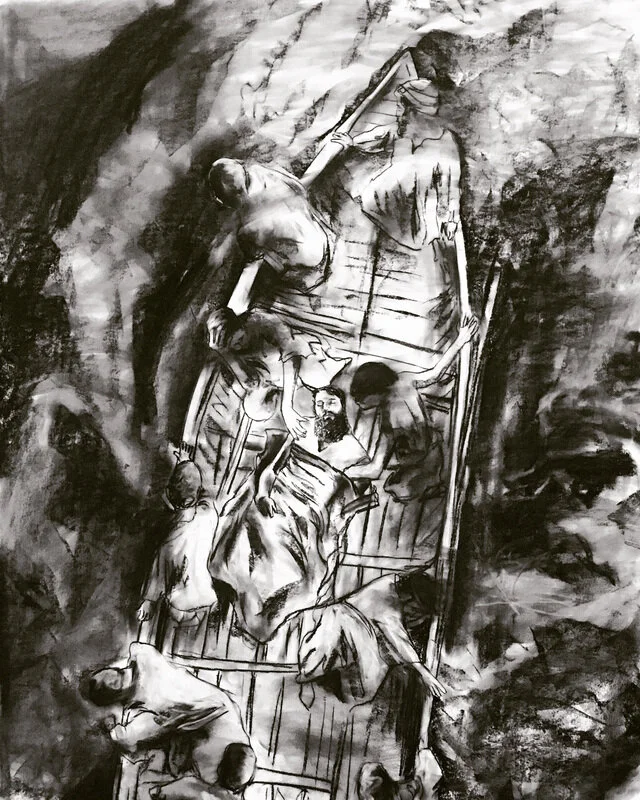
Peace (Mark 4:36-41) by Craig Hawkins, charcoal on paper, 2016

Peace (Mark 4:36-41) by Craig Hawkins, charcoal on paper, 2016

When Pastor Jamaal preached this past Sunday’s sermon, Opportunity for Lament, I already had Craig Hawkins’ drawing, Peace, on my mind . The drawing shows a bird’s eye view of one of my favorite Bible stories, the one where Jesus calms the storm.

Jesus is in a boat crossing the Sea of Galilee with his disciples. A storm arises, but Jesus remains sleeping through the storm. The worried disciples wake him up, saying, “Teacher, don’t you care if we drown?”

Jesus gets up, rebukes the wind and the waves: “Quiet! Be Still!” Then all is calm. Jesus says to his disciples, “Why are you so afraid? Do you still have no faith?” The story doesn’t supply the disciples’ response except to show their continued fear. It says, “They were terrified and asked each other, ‘Who is this? Even the wind and the waves obey him!’”

I think Craig Hawkins’ image of this story was on my mind because in this unprecedented time of coronavirus concerns, I identify with the disciples. I know Jesus is powerful over the wind and the waves and over viruses, too. Still, I can’t help responding like the disciples: “Jesus, don’t you care if this virus changes everything?”

The Bible, and especially laments like Psalm 44, give us reason to think such direct questioning might be ok.

Awake, Lord! Why do you sleep?
    Rouse yourself! Do not reject us forever.
Why do you hide your face
    and forget our misery and oppression?

We are brought down to the dust;
    our bodies cling to the ground.
Rise up and help us;
    rescue us because of your unfailing love.

- Psalm 44:23-26

Pastor Jamaal encouraged all of us to write our own psalm of lament using a guide which can be found here. I gave it a try and this is what I came up with below. If you write one and want to share, email me at mwinters@sojournchurch.com. I’d love to see what you wrote.

Jesus, I’ve heard the story how you calmed the sea

How you spoke to the wind and the waves

How the tempest heard your voice, and calmed.

The waters knew your voice from the first days of creation

when You separated the waters with your words.

But Jesus, before you calmed the sea

You were asleep and the disciples had to wake you

And were you upset with them for needing you?

You know they needed you, as we need you now

To calm our nerves, To calm our voices,

To calm our fears.

But are you again asleep?

Do we need to wake you from the bottom of some heavenly boat?

Louisville is shutting down, the world is shutting down.

Surely, you see it.

Jesus, do viruses know your voice?

On which day of creation did you make them?

Or does it not work like that? I’m sorry, I just don’t know.

We know we’re not without guilt -

We’ve caged what should not be caged

Freed what should not be freed

Jesus, you said to your disciples,

Why are you so afraid? Do you still have no faith?

And they didn’t really answer. What could they say?

What could we say?

It’s been 2,000 years.

You can calm the storm. You can calm virus surges.

God, have mercy on us.

_______________

Added: This new video from Pastor Jamaal also speaks directly to this post.

Otto Dix, the Gospel of Matthew, and Wirkungsgeschichte by Michael Winters

by Michael Winters

In 1960, the famed German Expressionist Otto Dix published a series of 33 lithographs depicting scenes from the Gospel of Matthew. The entire series of prints was on exhibit at the Sojourn Arts gallery January 12 - March 1, 2020. In this lecture, New Testament scholar Dr. Jonathan Pennington shares his reflections on the interaction between these images and the biblical text. 

Jonathan T. Pennington, who holds a Ph.D. in New Testament Studies from the University of St. Andrews (Scotland), is associate professor of New Testament Interpretation at The Southern Baptist Theological Seminary, where he is also director of the Ph.D. program. Pennington is the author of The Sermon on the Mount and Human Flourishing, Reading the Gospels Wisely, and Heaven and Earth In the Gospel of Matthew. He is also on the preaching staff at Sojourn East in Louisville, Kentucky.

Thanks to Bowden Collections, who loaned us the exhibit. And thanks to Dani Wallace of Love thy Neighborhood, who made the video for us.

Urban Stations artist Steve Prince featured on PBS by Michael Winters

by Michael Winters

During the season of Lent this year, our sanctuary will again feature the unique stations of the cross produced by artist Steve Prince. This series, which he calls Urban Stations, was created in collaboration with our church community during the summer of 2016.

Since then, Steve has worked on many other great collaborations, and he’s moved into exciting roles at William & Mary. Recently, Steve was featured on PBS’ Curate 757. You can watch the 8 minute clip below. The main project featured in the video, Linkages, uses a similar process to the one used to create Urban Stations.

The Urban Stations project by Steve Prince will be on view in our sanctuary beginning Ash Wednesday, February 26th, at our 6:30a.m. service, and they’ll remain up through Good Friday, April 10th.

A few years ago we produced the video below pairing Urban Stations with readings from Isaiah 53. Here you can see Steve’s original woodcuts in red, surrounded by the blocks made by participants inked in black.